Glossary of Ancient Epic Poetry Forms
Elements of Ancient Epic Poetry Forms
With a Focus on the Works of Homer
Composed by Rhey Cedron
Here you will find forty terms describing the vocabulary, recurring devices and components of ancient epic poetry, of the kind employed most famously throughout Homer's Iliad and Odyssey.
Before we dive in, consider this: every time you use the phrase “his Achilles' heel” or call your business trip an “odyssey,” you are speaking with words and terms thousands of years old. This glossary is a passport of sorts into understanding that ancient yet ongoing conversation. Read it then, not as a list of words to memorize, but as a set of keys to rooms hidden in the corners of stories you thought you already knew. Each word unlocks a door into a space where human beings have been trying to answer the same yearning questions for centuries: what does it mean to be heroic, to journey long, to suffer, to at last come home?
Homer didn't know he was writing “epic poetry,” he was just singing a song that had been sung for centuries before his time. He was transforming that song into newly formed written language, but he was still singing. The vocabulary below came later, invented by critics and grammarians trying to describe the beauty and wonder of what Homer passed on to us. So as we move through these terms, remember: you too are learning to sing those ancient songs.
Let's begin!
Origins & Settings
- Oral Tradition
- The transmission of stories, poems, and other cultural material by word of mouth. Epics like the Iliad emerged from communal oral performance over generations. Many ancient epics originated in oral tradition long before ever being written down.
- Aoidos
- Ancient figure of the singing bard, an oral poet-composer such as Demodocus in the Odyssey, who performs his own improvised or memorized verse, singing of Troy while Odysseus himself weeps at the tale of his own war.
- Rhapsode
- A professional performer of epic poetry in the Classical era, who recited (rather than composed) the verses of Homer and others before an audience at large gatherings and festivals. The name describes the creative act of weaving or sewing songs together. A rhapsody today is a musical piece which conveys an intense or enthusiastic emotion, such as Gershwin's “Rhapsody in Blue.” We are still with our feet in ancient Greece, however, as a rhapsode's payment was dependent upon his ability to stir and deeply sway the emotions of his audience. Even we ouselves, when we are said to be “waxing rhapsodic,” are carrying on an ancient tradition of speaking with heightened emotion.
- Bard/Scop
- The rhapsode's cousin in other cultures: the Celtic bard and the Anglo-Saxon scop (pronounced: shop) served similar roles, preserving genealogies, histories, and heroic deeds through memorized verse, often accompanied by a harp or lyre.
- Heroic Age
- A period in a culture's past, often mythical, characterized by great heroes and legendary events. Example: The Trojan War belongs to the Greek Heroic Age.
- Epic Cycle
- The broader body of now-fragmentary Greek epics surrounding the Trojan War, of which The Iliad and The Odyssey are the only two poems to survive complete. Among the lost are the Cypria, the Little Iliad and the Telegony. Perhaps, at most, some five percent of the ancient epic tradition survives to us; a sad and humbling thought.
- Oral-Formulaic Composition
- Long before ink was set to parchment, these poems lived in breath and memory. Singers composed while performing, stitching together pre-fabricated phrases, scenes, and rhythms (as “formulas”) like jazz musicians improvising over familiar chord changes. This theory, championed by Milman Parry and Albert Lord, revolutionized how we understand Homer; not as a solitary genius scribbling away on a scroll, but as a transmitter of centuries of communal voice.
- Myth
- A traditional story, often involving supernatural beings or events, that explains a cultural practice, belief, or natural phenomenon. Example: Greek mythology provides the foundation for many epic poems.
- Legend
- A story passed down through generations, often based on real events or people but embellished with fictional elements. Example: The legend of King Arthur has inspired many epic poems and stories.
- Epic Poem
- A long narrative poem, composed in an elevated style, recounting the deeds of a legendary or historical hero whose actions are of consequence to an entire people or age. From Greek: ἔπος / épos, “word” or “song.” How curious that the grandest form of storytelling humanity ever devised began with a word meaning nothing more than “speech.”
- The Homeric Question
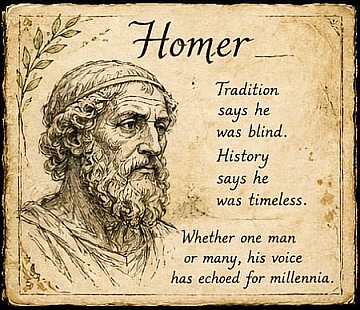
- The curiously unresolved mystery: Who, or what, was Homer? One poet? Many poets? A storytelling tradition personified? This question has fueled two centuries of passionate academic argument and reminds us that even our most foundational texts rest on legendary uncertainty.
Structural Conventions — How an Epic Is Built
- Books/Cantos
- The formal divisions of a long epic. Greek epics use “books” (the Odyssey has 24, one for each letter of the Greek alphabet—a lovely bit of structural elegance); Dante's Divine Comedy uses “cantos,” 100 in total, echoing the number's association with perfection and completeness.
- Proem
- The formal opening passage of an epic, typically stating its subject after invoking the Muse before the narrative proper begins. Every great epic begins with such a threshold space, an announcement at the entrance of what you are about to encounter.
- Invocation of the Muse
- The opening convention in which the poet calls upon a divine source of inspiration (a Muse, the Goddess of Memory or later, in Milton, the Holy Spirit) to grant the power to sing the tale truly, acknowledging that the story exceeds any single mortal's knowledge. It's a lovely humility: even Homer claims he's just the vessel.
- In Medias Res
- Latin for “into the middle of things.” Epics famously don't start at the beginning of the story but plunge us into the thick of the action, filling in backstory later through retelling, prophecy, or a bard-within-the-poem. The Iliad opens not with the war's start but in its tenth year, with a quarrel over a woman; the Odyssey begins with its hero already shipwrecked and yearning. This technique creates immediate tension and allows backstory to unfold through memory and narration, an engaging trick every modern screenwriter still steals.
- Epithet
- A recurring descriptive phrase fixed to a character or object, such as “swift-footed Achilles,” “wine-dark sea” or “rosy-fingered dawn.” These were employed by oral poets as an aid to memory for they fit the meter conveniently, serving as sort of a metrical building-block. Also called a stock epithet.
- Homeric Simile
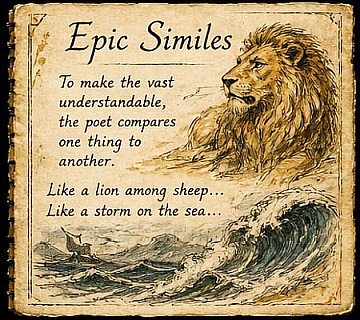
- An extended comparison, often spanning several lines, that momentarily transports us away from the battlefield chaos or stormy voyage into a scene of pastoral calm or domestic detail, only to snap us back with enhanced understanding. When Homer compares warriors falling to autumn leaves, he's doing more than describing; he's making mortality feel like nature's own rhythm. Sometimes referred to as an epic simile.
- Epic Hero
- Larger than ordinary humanity yet still mortal and flawed; possessing extraordinary strength, courage, or adaptability; representative of the values of an entire culture. Achilles embodies heroism and glory; Odysseus embodies cunning and endurance; each hero is a culture's answer to the question, “What does it mean to be great?”
- Epic Catalogue
- A formal listing, often of warriors, ships, or genealogies (see the famous Catalogue of Ships in Iliad Book 2). These passages, tedious to modern ears, once served as historical record, like the architecture of memory, and a kind of ritual honoring of the many by naming them into permanence.
- Type-Scene
- A recurring narrative pattern: launching a ship, offering hospitality or arming for battle, performed with slight variations each time it appears. These familiar, interchangeable elements could be adapted by the oral poet on the fly as suited each new performance.
- Ring Composition
- A structural technique where a narrative opens and closes with parallel imagery or language, ringing the story shut like a closed loop. Homer uses this constantly; it's the ancient ancestor of what we now call a frame narrative.
- Nekyia / Katabasis
- The hero's descent into the underworld to consult the dead. Odysseus performs it in The Odyssey Book 11, to seek advice from the prophet Tiresias; Aeneas follows him in The Aeneid Book 6, to seek council with his father, Anchises; Dante produced an entire Inferno out of this significant trial. This journey downward is never merely geographical, it's always a confrontation with mortality, memory, and the hero's own destiny.
- Nostos
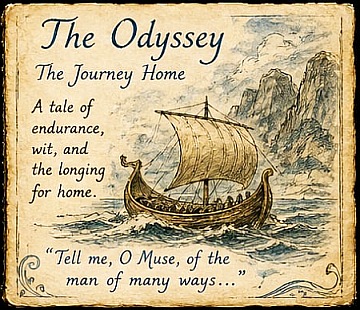
- The arc of homecoming, the safe (or thwarted) return of a warrior from war, which forms the structure of the entire Odyssey. νόστος, is the root of our modern word nostalgia, literally “the ache of returning.”
Poetic and Formal Devices
- Epic Convention
- Any recurring structural device expected within the genre (invocation, in medias res, catalogues, similes, etc.). Knowing the conventions is like knowing the rules of a sonnet, you appreciate the mastery more when you can see the scaffolding.
- Dactylic Hexameter
- The metrical heartbeat of Greek and Latin epic: six “feet” per line, each ideally a dactyl: one long/stressed syllable followed by two short/unstressed ones—BUM-ba-ba, though substitutions were common. This rolling, majestic rhythm was considered uniquely suited to grandeur; Romans called it simply heroicus, “the heroic meter.” Reading it aloud in the original Greek, you can feel why it was called “heroic verse” as it gallops along.
- Caesura
- A natural pause or break within a poetic line, often falling mid-foot. Skilled poets use caesura like a conductor uses silence—to create emphasis, breath, and dramatic weight exactly where the ear needs it.
- Patronymic
- A name derived from one's father, as in “son of Atreus” (Atreides) for Agamemnon, situating a hero within his lineage at every mention.
- Aristeia
- A hero's spotlighted battle scene, a sustained sequence where one warrior dominates the field. Diomedes gets one in Iliad Book 5; it's basically the ancient equivalent of a highlight reel.
- Anagnorisis
- The moment of recognition or discovery, often when a hero's true identity is revealed. Odysseus's scar on his thigh recognized by his old nurse Eurycleia is a masterclass in delayed, devastating anagnorisis.
- Menis
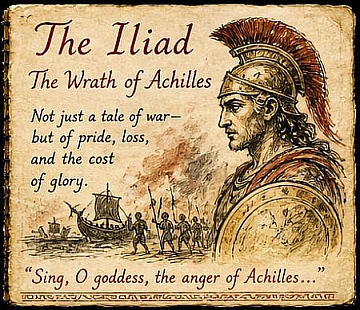
- “Wrath”: the destructive anger, often of a hero toward a slight upon his honor, that Iliad names in its very first word. μῆνις — a wrath reserved almost exclusively for gods and the greatest of heroes.
- Theomachy
- A “battle of the gods,” in which the divine pantheon takes sides and clashes alongside (or instead of) the mortal armies below.
- Deus ex Machina
- “God from the machine”: divine intervention that resolves a mortal impasse, as Athena's descent restores peace at the very close of The Odyssey.
- Digression
- A deliberate departure from the main narrative to convey a related story, genealogy, or memory, expanding the poem's scope beyond its immediate action.
- Ekphrasis
- A vivid poetic description of a visual artwork, most famously the Shield of Achilles in The Iliad Book 18, where Homer describes an entire cosmos: cities, harvests, weddings, war, forged onto a single object. This is poetry pausing to marvel at art describing life describing art.
Underlying Themes — The Spirit of Greece
- Xenia
- Guest-friendship: the sacred, reciprocal obligation of hospitality between host and stranger (protected by Zeus himself), whose violation drives much of the plot in both Homeric epics. The Odyssey is practically a field guide of good and bad xenia; the Phaeacians honor it gracefully; the suitors devouring Odysseus's household violate it monstrously. Paris abuses Menelaus's hospitality by absconding with Helen and the resulting disaster is, well ... epic. Transgressions against xenia were treated as cosmic offenses, not mere social faux pas, for hospitality was, quite literally, holy.
- Arete
- Excellence or virtue in the fullest sense: moral, physical, and intellectual. To possess arete was to fulfill your highest human potential in every visible way, which is precisely what epic heroes are built to display
- Kleos
- Glory, fame, renown; specifically the kind that outlives you, sung by later generations. Achilles's entire tragedy weaves around his choosing kleos (a short life, eternal glory) over a long, unremembered one. For the ancient Greeks, if the poets sing of you, you will never die. Three thousand years on— we still know his name. κλέος — literally, “that which is heard.”
- Moira
- The invisible thread binding even gods to destiny's design. Ancient epic constantly wrestles with the tension between what is fated and what heroes freely choose, a philosophical knot no less relevant to us moderns pondering free will amid daily circumstance.
- Timê
- Honor, status, the public recognition of one's worth—often measured in spoils, respect, and precedence. The Iliad's plot ignites because Agamemnon strips Achilles of timê by taking his war-prize, Briseis. An entire epic, sparked by a wound to honor.
- Hamartia
- Though we associate this "fatal flaw" more with Greek tragedy, it echoes through epic heroes too: Achilles's rage, Odysseus's pride (his taunting of the Cyclops costs him dearly), the crack in the marble that makes the hero human rather than a god.
- The Divine Machinery
- The gods, fates, and supernatural forces that intervene directly in human affairs, reminding us that in the epic worldview, human agency and divine will are always tangled together; you never quite know whose hand is really on the spear
Ancient Threads of Epic Lore
Elusive Homer“The name Homer now stands for ancient Greek epic poetry. We know nothing of the man and his life. In times past, scholars asked with regard to his birthplace, but now they ask rather where epic poetry had its rise. How much of the poems, as we have them, is due to any one poet, no one can say. Doubtless the poet who gave them their unity used very freely older lays and poetic material of every sort, adapting this to his use, while the bards who followed our Homer added verses, brief passages, or even whole lays.”
—John Henry Wright, Masterpieces of Greek Literature, 1902
“In the 3rd century B.C., we come upon a figure which preserves a definite character; this is Aristoxenus, the disciple of Aristotle, who gave his undivided attention to rhythm, and who lives, unfortunately only in fragments, as the most eminent musical critic of antiquity. The brief fragments of his Elements of Rhythm ( ρυθμικά στοιχεία ) originally written in three books, are of unsurpassed value to us as illustrating the attitude of classical Greece to the interrelation of verse and music.”
—Edmund William Gosse, Verse, 1911
“Poetry in general seems to have sprung from two causes, each of them lying deep in our nature. First, the instinct of imitation is implanted in man from childhood, one difference between him and other animals being that he is the most imitative of living creatures, and through imitation learns his earliest lessons. The cause of this is, that to learn gives the liveliest pleasure, not only to philosophers but to men in general.
Imitation, then, is one instinct of our nature. Persons, therefore, starting with this natural gift developed by degrees their special aptitudes, till their rude improvisations gave birth to poetry.”
—S. H. Butcher, Aristotle's Poetics, 1895
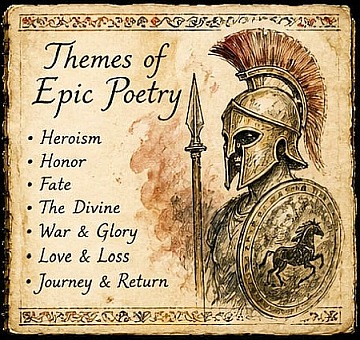
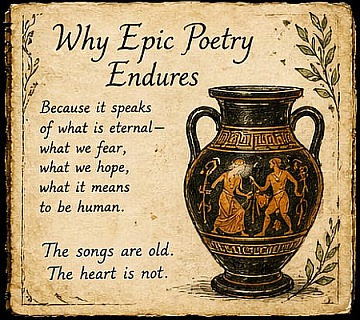

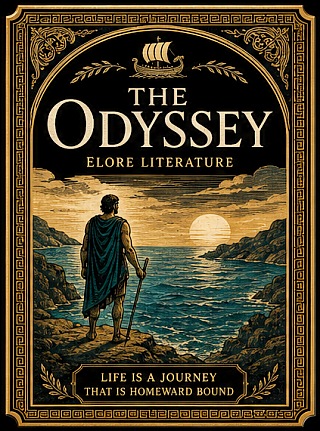
 Lore is a distributed wisdom, accumulated by the creative foundry of collective human culture itself. Lore
functions as a process of meaning-craft, performing an evolutionary natural selection as it carries knowledge
forward. Stories that survive across time are not necessarily the most historically accurate or the most
sophisticated. The tales that get passed on are the ones that convey something so essential about the human
experience that people feel compelled to keep telling them, generation after generation.
Lore is a distributed wisdom, accumulated by the creative foundry of collective human culture itself. Lore
functions as a process of meaning-craft, performing an evolutionary natural selection as it carries knowledge
forward. Stories that survive across time are not necessarily the most historically accurate or the most
sophisticated. The tales that get passed on are the ones that convey something so essential about the human
experience that people feel compelled to keep telling them, generation after generation.